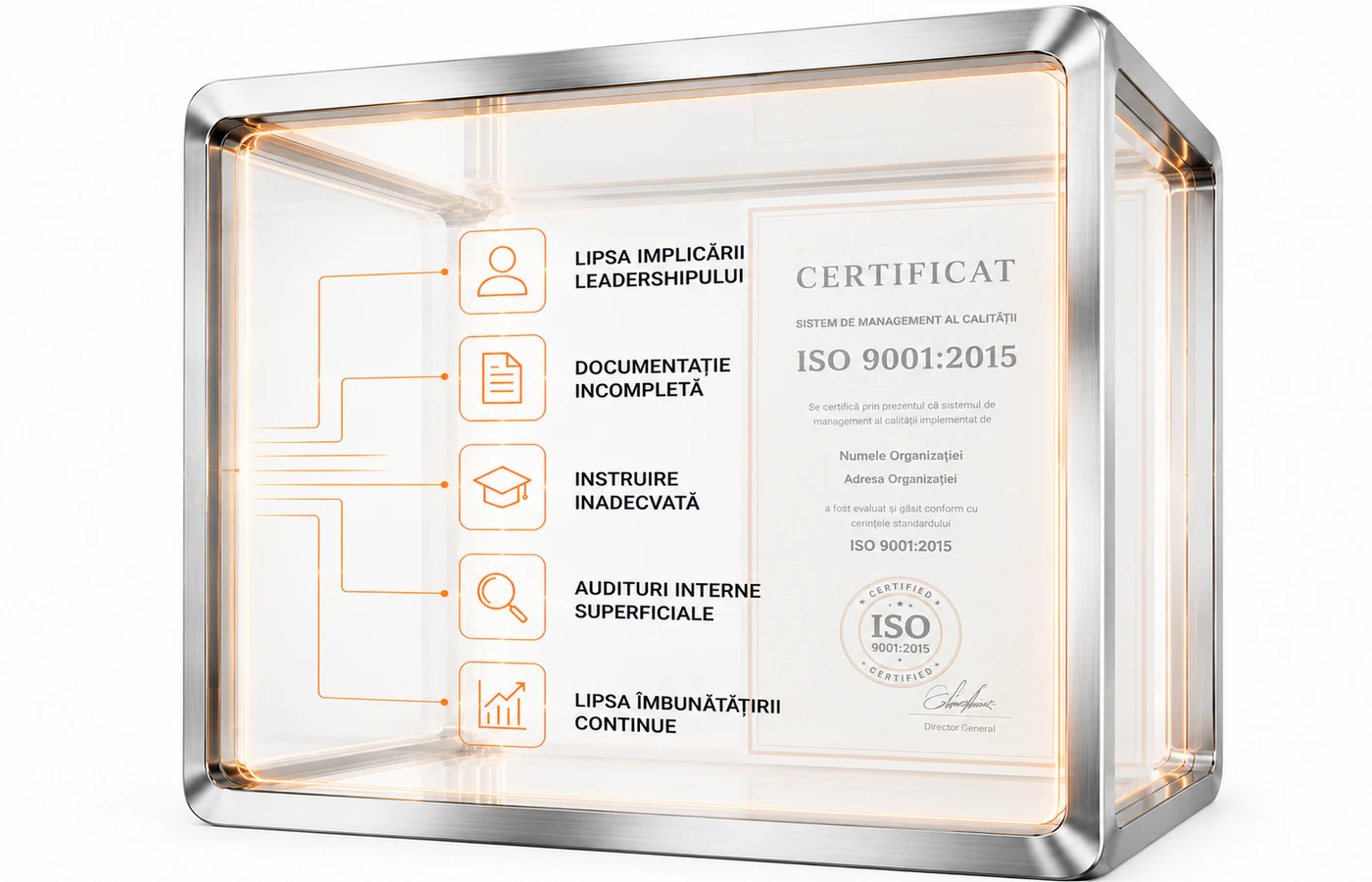
Certification does not stall on the day of the audit
An external audit rarely creates the problems of a management system. Most of the time, it only makes them visible. Certification projects stall weeks or months earlier, when requirements are treated as a formality, responsibilities remain unclear and the organization produces no evidence that the system works.
ISO certification is not an exam based on memorizing the standard, nor a check limited to procedures. Auditors look at whether processes are controlled, whether people know their roles, whether risks are managed and whether the organization learns from problems. A system can look good on paper and still be vulnerable at the audit.
Contents
What a stalled ISO project looks like in practice
A project is not stalled only when the audit has been postponed. The signs appear earlier: documents are finalized but not used; indicators exist but are not analyzed; training is recorded but employees cannot explain the processes; the internal audit was closed without relevant findings; the management review repeats general information without decisions or responsibilities.
In these situations, the organization has elements of a system but not yet a coherent system. The requirements of the standard are handled separately, and the link between context, risks, objectives, processes, audit and improvement cannot be demonstrated.
Signs that the project is at risk
- responsibility for ISO is handed to a single person;
- procedures describe a way of working that differs from actual practice;
- records are filled in retrospectively, just before the audit;
- nonconformities are closed with corrections, without root cause analysis;
- management only attends the audit opening meeting;
- the organization cannot demonstrate results and trends.
1. Lack of leadership involvement
The first and most costly mistake is treating certification as the quality manager's project. Modern management system standards require leadership involvement because processes, resources, priorities and risks cannot be controlled from outside management.
When leaders are not involved, objectives remain formal, conflicts between processes are not resolved and the people in charge lack the authority needed to implement changes. At the audit, the problem becomes visible through inconsistent answers, a lack of documented decisions, insufficient resources or the absence of a clear link between the system and the organization's direction.
How to correct it
Top management must set relevant objectives, allocate resources, monitor performance and take a real part in the management review. Involvement does not mean signing the policy, but making decisions based on the data generated by the system.
2. Generic or incomplete documentation
Documentation becomes an obstacle when it is copied from other organizations, written without the participation of process owners or drafted solely to answer specific clauses. An auditor does not assess how elegant the procedures are, but the consistency between what is documented, what staff say and what actually happens.
Generic documentation produces contradictions: roles that do not exist, forms that are not used, indicators that are impossible to calculate, workflows that ignore the actual applications and controls. Incomplete documentation has the opposite effect: critical activities lack clear criteria and evidence cannot be traced.
How to correct it
Every document must have an operational purpose. The process must be described together with the people who carry it out, and the level of documentation must be adapted to risk, complexity and staff competence. Document control must ensure that versions are correct, accessible and protected.
3. Insufficient training
A general presentation of the standard is not enough. Employees need to understand what changes in their work, what responsibilities they have, what evidence they must keep and what consequences may arise when requirements are not met.
At the audit, insufficient training shows when staff cannot explain the relevant objectives, do not know the process criteria, use outdated documents or apply the same requirements inconsistently. An attendance list demonstrates participation, not competence.
How to correct it
The training plan must start from roles and risks. Effectiveness can be checked through observation, practical assessments, review of results, interviews or audit. For critical functions, evidence of competence must be kept, not just of attendance.
4. Superficial internal audit
The internal audit is the main opportunity to uncover problems before the external assessment. Yet many organizations reduce it to filling in a checklist. An audit that identifies no problems in a new or changing system should be examined critically.
An effective internal audit follows the process trail, checks evidence, compares practice with criteria and assesses whether planned results are achieved. The auditor must be sufficiently independent of the activity audited and have the competence needed to formulate clear findings.
How to correct it
The audit programme must be based on risk and on the importance of processes. Findings must be supported by verifiable evidence, and corrective actions must be followed up until their effectiveness is confirmed. To prepare, the organization can use the service of ISO internal audit.
5. Lack of continual improvement
A system that produces no change is hard to defend at the audit. Improvement does not mean spectacular projects, but the ability to use data, complaints, incidents, nonconformities, audits and process results to make better decisions.
The blockage occurs when the organization collects information without analyzing it. Indicators are reported, but there are no thresholds, trends or actions. Nonconformities are corrected case by case, without eliminating the cause. The management review is limited to a presentation, without decisions or deadlines.
How to correct it
The organization must define its sources of improvement, prioritize actions by risk and impact and check the results. Evidence may include process changes, fewer errors, higher conformity, shorter lead times, fewer incidents or improved customer satisfaction.
How these mistakes show up at the certification audit
The external auditor samples processes, locations, people and records. A single error does not automatically block certification, but a repeated pattern may indicate a systemic problem. For example, one missing record may be an isolated deviation; a consistent lack of evidence across several processes may show that the control mechanism is not working.
Major nonconformities are usually associated with the absence or failure of an essential element of the system, or with a situation that calls into question the organization's ability to achieve its planned results. The final decision belongs to the certification body, not the consultant.
How to get the certification project moving again
Getting unstuck starts with an honest assessment of the current status. Quickly producing more documents is not effective if the real problem is lack of implementation. A well-conducted GAP analysis separates requirements that are not implemented from requirements that are implemented but not demonstrated.
- Clarify the scope and criteria. Confirm the standard, locations, processes, products and applicable requirements.
- Assess the gaps. Check the documents, practice, responsibilities and evidence.
- Prioritize by risk. Address first the gaps that may affect conformity, the customer or the results of the system.
- Implement and generate evidence. Processes must be applied long enough to demonstrate that they work.
- Internal audit and management review. The organization evaluates its system and makes decisions before the external audit.
- Close out the actions. A correction is not enough; effectiveness must be verified.
For organizations that need help structuring the stages, QMS Consulting offers ISO consulting and ISO certification preparation.
Checklist before the certification audit
- the scope of the system and the processes are defined and up to date;
- legal, contractual and customer requirements are identified;
- risks and opportunities have actions and owners;
- objectives have indicators, deadlines and analyzed results;
- the documents in use are approved and in the correct version;
- staff can explain the relevant responsibilities and controls;
- the internal audit covers the scope and processes of the system;
- nonconformities have analyzed causes and verified actions;
- the management review is completed and contains decisions;
- evidence is accessible and can be traced back to the process that generated it.
The role of the consultant and the role of the certification body
The consultant helps the organization interpret the requirements, design the system, develop competence and prepare for the audit. The certification body performs the independent assessment and decides whether to grant the certificate. Separating these roles protects the impartiality of the process.
A competent consultant does not promise certification and does not hide problems. They help the organization build a system it can explain, apply and sustain after the audit. The certificate is an important result, but long-term value comes from process control and performance improvement.
Standards for which these risks are most often relevant
The five mistakes appear in projects for many management system standards. Requirements and risks differ, but the principles of leadership, competence, audit and improvement remain essential.
- ISO 9001:2026 – Quality management systems — Requirements
- ISO 14001:2026 – Environmental management systems — Requirements with guidance for use
- ISO/IEC 27001:2022 – Information security, cybersecurity and privacy protection — Information security management systems — Requirements
- ISO 45001:2018 – Occupational health and safety management systems — Requirements with guidance for use
- ISO 22000:2018 – Food safety management systems — Requirements for any organization in the food chain
Conclusion
ISO certification stalls when the organization tries to demonstrate at the audit a system that has not yet been integrated into its day-to-day work. Leadership involvement, applicable documentation, people's competence, internal audit and continual improvement are not separate elements. Together, they show that the system is under control and capable of producing results.
The earlier problems are identified, the more predictable and less costly the remediation. Serious preparation is not only about passing the audit, but about building an organization that can sustain certification over time.
Related resources
Frequently asked questions
What can block ISO certification?
Certification can be delayed or blocked by a lack of leadership involvement, documentation that does not reflect actual work, insufficient training, a superficial internal audit and a lack of improvement actions. These problems become critical when the organization cannot present consistent evidence that the system is applied.
Can you fail the certification audit?
Yes. A certification body may identify major or minor nonconformities. In the case of major nonconformities, certification is not granted until the organization implements effective corrective actions and demonstrates them.
Is an internal audit mandatory before certification?
Yes. For management system standards, the internal audit is an essential requirement. The organization must demonstrate that it has evaluated its own system, identified nonconformities and followed up on corrective actions.
How long does it take to fix problems before the audit?
It depends on the extent and cause of the problems. Some documentation corrections can be made quickly, but shortcomings related to processes, competence, data or the effectiveness of actions take time to implement and to build up evidence.
Who issues the ISO certificate?
The ISO certificate is issued by an independent certification body. The consultant can support the organization with implementation and preparation, but does not issue the certificate and must not replace the independent assessment.
Can the consultant take part in the certification audit?
The consultant can support the organization within the limits accepted by the certification body, but responsibility for presenting and operating the system lies with the organization. The external auditor must preserve the independence and impartiality of the assessment.
What happens if major nonconformities are raised?
The organization must analyze the cause, define and implement corrective actions, and then present evidence of effectiveness. The certification body may require additional verification before making the certification decision.
How should an organization prepare properly for the audit?
Proper preparation includes checking the scope of the system, updating the applicable documents, training key people, conducting the internal audit and the management review, closing nonconformities and checking the evidence generated by processes.
Don't wait for the external audit to discover the obstacles
A structured review before certification reduces uncertainty and allows problems to be addressed in the right order.
The review must follow the link between requirements, processes, responsibilities and evidence. The aim is not to simulate an audit in order to rehearse answers, but to confirm that the system works without artificial intervention.
Priorities before the audit
- close nonconformities with evidence of effectiveness;
- review high-risk processes and objectives not yet achieved;
- prepare key people to explain how the work is actually done;
- confirm the internal audit and the management review.
Prepare your organization for certification
GAP analysis, consulting, internal audit and technical support to identify and remove obstacles before the external audit.
Direct contact
Phone: +40 722 773 446
Email: contact@qms.ro
Address: 12 Petru Rareș Street, Bucharest
Request a call