ISO is not just a certificate on the wall
For many organizations, interest in ISO starts with a commercial requirement: a customer asks for certification, a tender requires proof of conformity or the company wants access to a new market. The certificate becomes the visible goal. But a well-implemented ISO management system means much more.
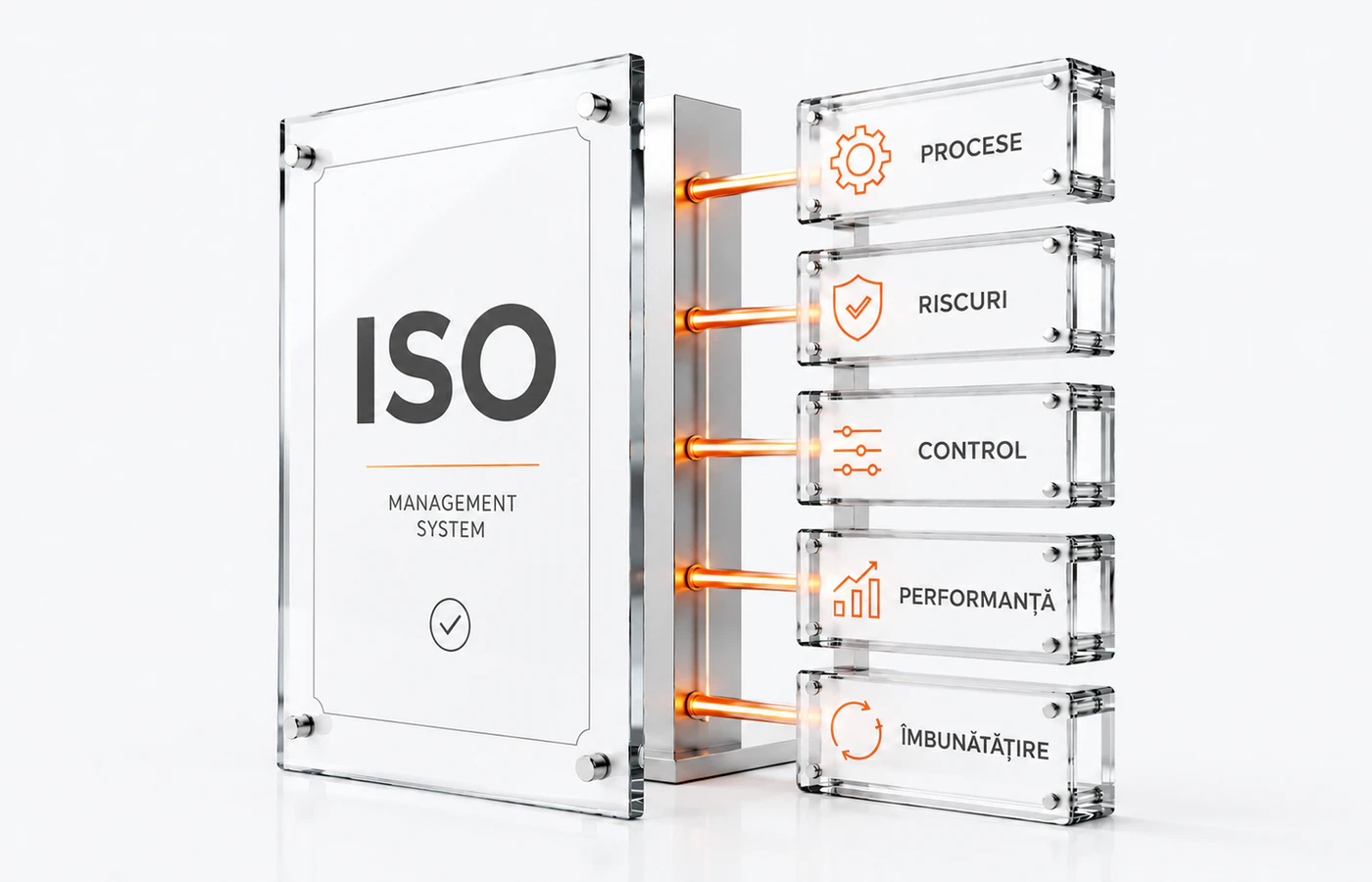
In practice, the system is the framework through which the organization defines its processes, responsibilities, risks, controls and objectives, and how it checks whether results are as expected. The standard provides the structure; the company must adapt it to how it actually works.
A good ISO system does not create a parallel organization for the auditor. It makes the real work clearer, more controllable and easier to improve.
How does a management system work in concrete terms?
Take a simple process: an order is received, reviewed, planned, carried out, checked and delivered. If a problem occurs, the organization must be able to identify where it happened, who is responsible, what risk was overlooked and what needs to change so that the situation does not happen again.
This logic links day-to-day work to the requirements of the standard. Documentation is there to support the system, not to replace it.
The 6 components that make the difference
Clear processes
It is defined what happens, in what order and what result must be achieved.
Real responsibilities
People know who decides, who carries out the work and who checks it.
Controlled risks
Significant problems are anticipated and addressed in proportion to their impact.
Useful indicators
Data is used for decisions, not just reported formally.
Relevant audit
The internal audit checks implementation and effectiveness, not just the existence of documents.
Improvement
Nonconformities and deviations lead to actions that address the cause, not just the effect.
A system built for the certificate vs. a system built for the business
Two companies can hold the same certification and have systems of very different maturity. The difference shows between two audits, when there is no immediate certification pressure.
| Certificate-driven | Integrated into the business |
|---|---|
| Generic procedures | Rules adapted to real processes |
| Documents prepared just before the audit | Information updated when the work changes |
| Indicators reported formally | Indicators used for decisions |
| Audit focused on documents | Audit focused on conformity and effectiveness |
| Superficial corrective actions | Causes analyzed and effectiveness verified |
A practical example: late deliveries
A company receives repeated complaints about late deliveries. The solution is not automatically a new procedure. A working system starts with root cause analysis: are orders confirmed without checking capacity? Does planning receive information too late? Are suppliers causing delays? Are the promised lead times unrealistic?
Once the cause has been identified, the organization can introduce the right control: checking capacity before confirming the deadline, an on-time delivery indicator, clearer criteria for suppliers or an escalation rule.
The role of the system is not to produce documents for every problem, but to create a repeatable mechanism through which problems are identified, controlled and prevented.
Which ISO standard suits your organization?
The choice must start from objectives, risks and commercial requirements.
- ISO 9001:2026 — Quality management systems — Requirements
- ISO 14001:2026 — Environmental management systems — Requirements with guidance for use
- ISO 45001:2018 — Occupational health and safety management systems — Requirements with guidance for use
- ISO/IEC 27001:2022 — Information security, cybersecurity and privacy protection — Information security management systems — Requirements
- ISO 22000:2018 — Food safety management systems — Requirements for any organization in the food chain
- ISO 50001:2018 — Energy management systems — Requirements with guidance for use
Some organizations implement a single standard, others choose an integrated management system. The right decision depends on the business and on what the organization wants to control or demonstrate.
How long does implementation take?
There is no universal timeframe. The duration depends on the size of the company, the complexity of the processes, the number of sites, the chosen standard, the current level of organization and the availability of the internal team.
A realistic estimate starts with an analysis of the current situation. A GAP analysis can show what is already compliant, what is missing and where the greatest risks lie. From there, an implementation plan proportionate to the organization can be built.
When is it worth hiring an ISO consultant?
Consulting is useful when the organization wants to shorten implementation time, avoid unnecessary documentation or turn an existing system into a more efficient one.
- there is a contractual deadline for certification;
- there is not enough internal competence to interpret the standard;
- the current system has become too bureaucratic;
- recurring nonconformities occur;
- the organization wants to integrate several standards;
- an independent assessment is needed before the certification audit.
Well-done ISO consulting should not just deliver templates. It should help the organization build a system it can use and maintain on its own.
Quick checklist: does your system work or does it just exist?
- Are processes and responsibilities clear to the people who actually do the work?
- Do indicators lead to concrete decisions?
- Do significant risks have real controls?
- Does the internal audit identify relevant problems?
- Do corrective actions address the causes?
- Does the documentation reflect how work is really done?
Conclusion
Certification can open doors and meet important commercial requirements. But long-term value appears when the system is used daily to control processes, manage risks and improve performance.
A good ISO management system must be robust enough to provide control and simple enough to be used in practice.
Useful resources
Frequently asked questions
What is an ISO management system?
It is the framework through which an organization organizes its processes, responsibilities, risks, controls, objectives and improvement mechanisms in line with the requirements of a relevant standard.
Is ISO certification the same as implementing a management system?
No. Implementation means building and applying the system. Certification is the independent assessment of the system's conformity by a certification body.
How do I choose the right ISO standard?
The choice depends on objectives, industry, risks and customer requirements. ISO 9001:2026 covers quality, ISO 14001:2026 the environment, ISO 45001:2018 occupational health and safety, and ISO 27001:2022 information security.
Does QMS Consulting issue ISO certificates?
No. ISO certificates are issued by independent certification bodies. QMS Consulting provides consulting, internal audit, training and certification preparation.
Do you want an ISO system that keeps working after certification?
QMS Consulting provides consulting for implementing and improving ISO management systems, internal audit, training and certification preparation.
Direct contact
Phone: +40 722 773 446
Email: contact@qms.ro
Address: 12 Petru Rareș Street, Bucharest
Talk to an ISO consultant