ISO 9001:2026 has been published. What it means for certified organizations
On 16 September 2026, ISO published the sixth edition of ISO 9001, which replaces ISO 9001:2015. For certified organizations, a three-year transition period begins, at the end of which certificates issued against the 2015 edition are no longer valid.
The good news is that the structure of the standard stays the same and the core principles do not change: customer focus, the process approach, risk-based thinking and continual improvement. The 2026 edition clarifies and strengthens several requirements, especially those related to leadership, quality culture, risks and opportunities. For a system that already works, the transition means targeted adjustments, not a re-implementation.
Contents
Transition timeline: the dates that matter
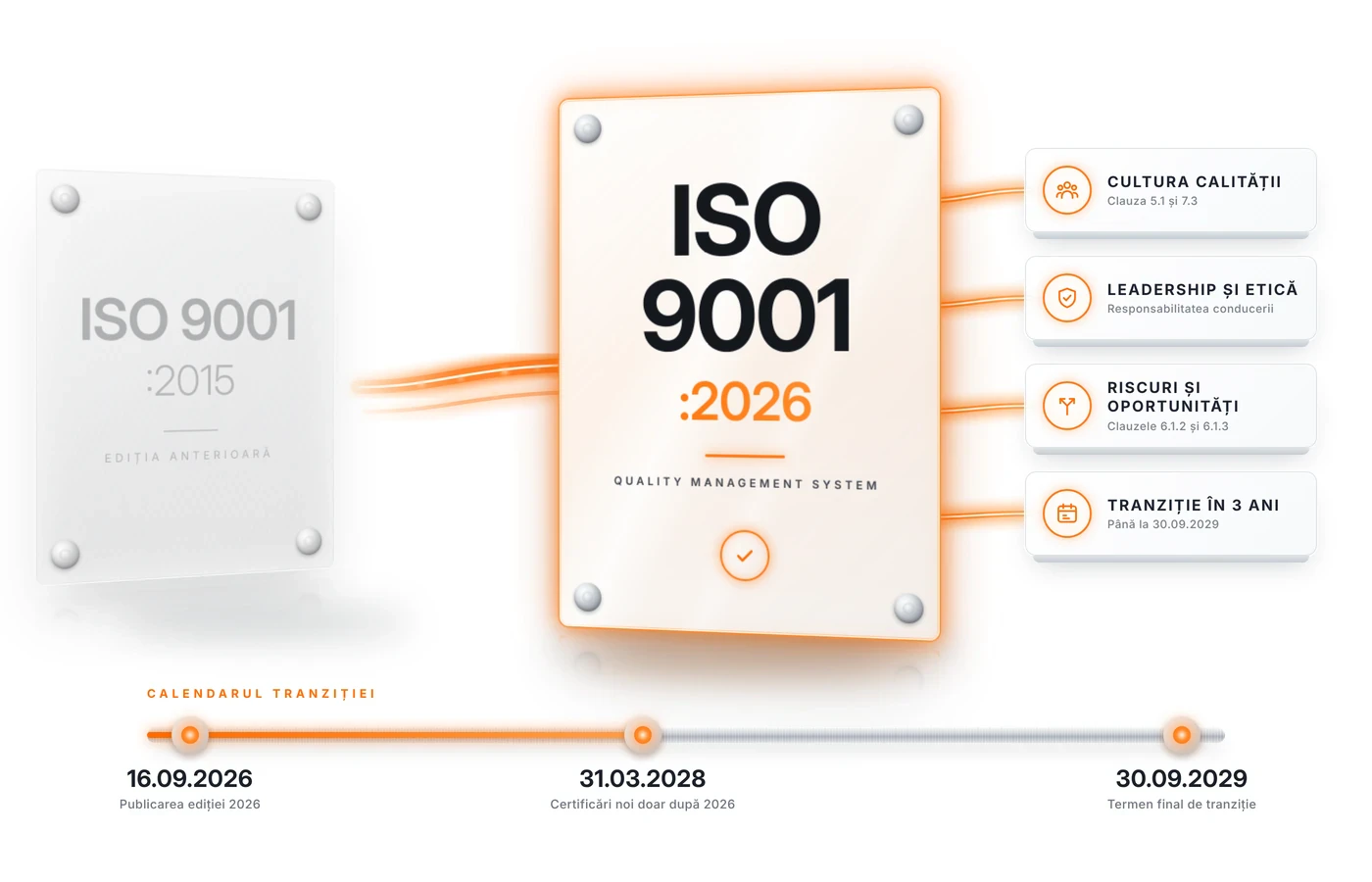
The transition requirements are set by Global ACI, the international accreditation organization formed by the merger of IAF and ILAC, in document Global ACI-TECH-3-TR. The key dates are:
- 16 September 2026: publication of ISO 9001:2026 and start of the three-year transition period;
- 31 March 2028: from this date, accredited initial certifications are issued only against ISO 9001:2026;
- 30 September 2029: accredited ISO 9001:2015 certificates lose their validity; all certified organizations must have transitioned to the 2026 edition.
Certification bodies must first be accredited for the new edition, and this process can take several months. The date from which your certification body can audit against ISO 9001:2026 and the format of the transition audit (at surveillance, at recertification or separately) are agreed directly with the certification body.
In practice, organizations with recertification in 2027 or 2028 can transition at the same time as recertification. Those with recertification in 2029 should not wait until then: the transition can also be done at a surveillance audit, and towards the end of the period auditor availability will be limited.
What changes in ISO 9001:2026
The changes do not introduce a new set of mandatory documents. They require certain things that a good system already does to be more explicit and demonstrable.
1. Quality culture and ethical behaviour
Top management becomes explicitly responsible for promoting a quality culture and ethical behaviour (clause 5.1). The concept appears in several places in the standard, including awareness (7.3): employees must understand what quality culture means in their organization. At the audit, culture is not demonstrated through a statement, but through decisions, behaviours and the way problems are handled.
2. Risks and opportunities, addressed separately
Clause 6.1 separates risks (6.1.2) from opportunities (6.1.3). The organization must determine, analyze and evaluate the risks that may affect its ability to consistently deliver conforming products and services, and show how it addresses each risk and each opportunity. A mixed register filled in as a formality will be harder to defend at the audit.
3. Quality policy, context and strategic direction
The quality policy must take into account the context of the organization and support its strategic direction. The analysis of context still includes the relevance of climate change, a requirement introduced by the 2024 amendment to the 2015 edition and carried over into the new edition.
4. Documented information worded more clearly
The wording on documents and records has been clarified. Where the standard requires documented information "as evidence", this means records. The distinction helps avoid excessive documentation.
5. Other clarifications
- communication with customers about contingency actions, where relevant (8.2.1);
- guidance for planning and carrying out changes to the system (6.3);
- recognition of social media as a source of information on customer perception (9.1.2);
- a much expanded Annex A, which explains the intent of the requirements. The annex is informative and is not audited.
The list summarizes the main changes. For the exact interpretation of the requirements, the reference remains the official text of the standard.
What stays the same
ISO 9001:2026 keeps the harmonized structure common to ISO management system standards, with the same ten clauses. Processes, objectives and indicators, internal audit, management review, handling of nonconformities and corrective actions work the same way. Existing documentation remains valid and is updated only where the new requirements call for it. As in the 2015 edition, a quality manual is not mandatory.
Thanks to the common structure, organizations with integrated systems can plan the ISO 9001 transition together with the transition to ISO 14001:2026, published in April 2026.
How to plan the transition in 6 steps
- Train key people. The system manager, internal auditors and top management must know the changes before changing anything in the system.
- GAP analysis against the 2026 edition. Check in particular quality culture, risks and opportunities, the policy, awareness and documented information.
- Update only what is necessary. Typically: the risk methodology, the record of opportunities, the quality policy, training materials and the audit programme.
- Implementation and evidence. The new requirements must operate long enough to produce records that can be verified.
- Internal audit and management review against ISO 9001:2026. The organization evaluates its system against the new edition and closes the findings.
- Schedule the transition audit. Agree the date and format of the audit with the certification body in good time.
For the GAP analysis and updating the system, QMS Consulting offers ISO consulting, and for the check before the transition audit, ISO internal audit.
Mistakes to avoid in the transition
- rewriting all the documentation, even though the structure of the standard has not changed;
- postponing the transition until 2029, when auditors will be hard to book;
- treating quality culture as a new document instead of demonstrable behaviours and decisions;
- internal auditors who have not been trained on the new edition;
- a copied register of risks and opportunities, without real analysis.
ISO 9001:2026 transition checklist
- the ISO 9001:2026 standard is available in the organization;
- top management and internal auditors know the changes;
- the GAP analysis against the 2026 edition is completed;
- the quality policy reflects the context and strategic direction;
- risks and opportunities are analyzed and addressed separately;
- employees can explain what quality culture means in their work;
- the internal audit and management review have been carried out against the new edition;
- the date of the transition audit has been agreed with the certification body.
Conclusion
ISO 9001:2026 does not change the foundation of a quality management system, but it requires leadership, quality culture and the handling of risks and opportunities to be more visible and easier to demonstrate. Organizations that start early can transition along with a planned audit, without extra time costs and without the pressure of the September 2029 deadline.
Related resources
Frequently asked questions about ISO 9001:2026
When was ISO 9001:2026 published?
On 16 September 2026. It is the sixth edition of the standard and replaces ISO 9001:2015.
By when must the transition to ISO 9001:2026 be completed?
Accredited ISO 9001:2015 certificates are valid until 30 September 2029 at the latest. By then, certified organizations must undergo a transition audit against the 2026 edition.
Can I still obtain a new ISO 9001:2015 certification?
Only in the first part of the transition period, and the certificate expires on 30 September 2029 at the latest. From 31 March 2028, accredited initial certifications are issued only against ISO 9001:2026. For a new certification, it makes sense to implement the 2026 edition directly.
Does all the documentation have to be redone?
No. The structure of the standard stays the same. Typically, the quality policy, the approach to risks and opportunities, awareness materials and the audit programme are updated, plus the evidence related to quality culture.
What does quality culture mean in ISO 9001:2026?
The values, attitudes and behaviours that influence the quality of products and services. Top management must promote it, and the organization must be able to show how it is reflected in decisions, communication and the way problems are handled.
Who carries out the transition audit?
The certification body that issued the certificate, once it is accredited for the new edition. QMS Consulting does not issue certificates; we can support you with the GAP analysis, updating the system, training and the internal audit before the transition.
Check how ready your system is for the 2026 edition
A short GAP analysis shows exactly what needs to be updated and avoids unnecessary work on documents that remain valid.
The analysis must focus in particular on the new or clarified requirements: quality culture, risks and opportunities, the policy and awareness. The result is a prioritized list of actions and a realistic schedule up to the transition audit.
Transition priorities
- train internal auditors on the 2026 edition;
- separate risks from opportunities;
- prepare evidence of quality culture;
- schedule the transition audit in good time.
Prepare the transition to ISO 9001:2026
GAP analysis against the 2026 edition, updating the system, training internal auditors and an internal audit before the transition audit.
Direct contact
Phone: +40 722 773 446
Email: contact@qms.ro
Address: 12 Petru Rareș Street, Bucharest
Request a call